The Central Bank raised interest rates in May because a war pushed up the price of oil. If that war ends, the reason for the increase disappears, but the next scheduled meeting is not until the end of September.
| The argument, in short. On 25 May the Monetary Policy Board raised its interest rate by a full percentage point. The reason it gave was an oil shock caused by the war in the Middle East, together with signs that spending in the economy was picking up. On 21 July it left the rate alone. Its next scheduled meeting is 29 September. That is a gap of seventy days. Inside that gap sits a war that has already ended once, in June, and restarted. If it ends again, properly this time, the price of oil falls, the pressure on the rupee eases, and most of the reasoning behind the May increase stops applying. Under the current calendar, nobody at the Central Bank is scheduled to notice until the end of September. This piece does not argue that the Board should cut rates. It argues something narrower and, we think, harder to refuse: the Board should say publicly that it is on standby, that it will convene within a defined number of days of a durable ceasefire, and that it will publish in advance the handful of things it would look at. Standby costs nothing. Not being on standby costs up to seventy days of a policy set for a world that no longer exists. |
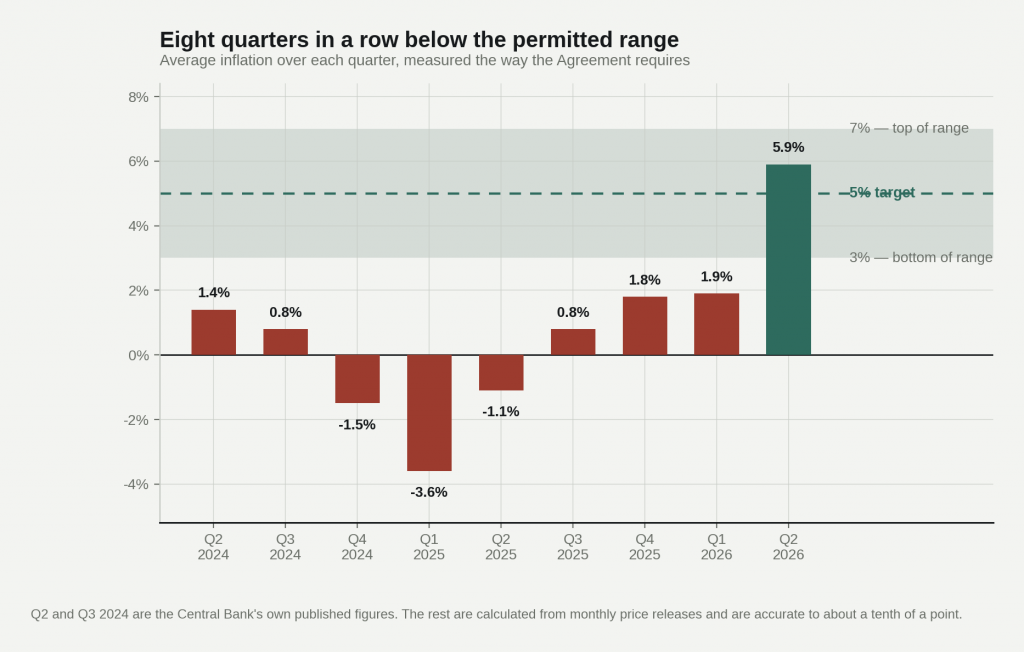
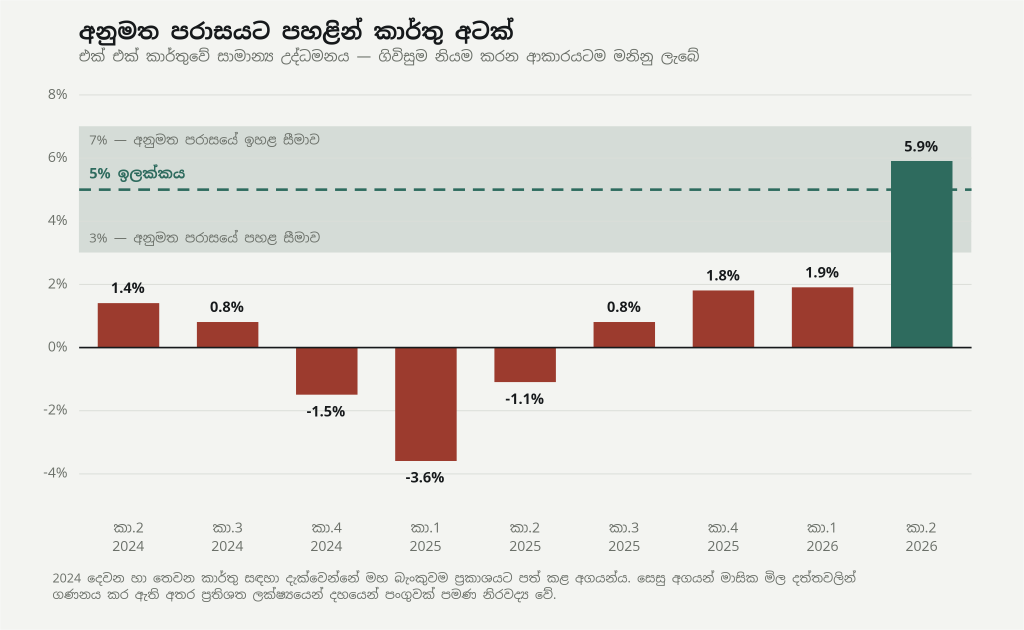
Sri Lanka’s inflation came back to 5% in the second quarter of this year, for the first time since the framework was signed. The Central Bank has described this as policy working. The more accurate description is that a war in the Middle East arrived and did the job early.
This is not our inference. It is what a Deputy Governor said at the July press conference, on the record. Asked why the Board would not meet again before September, he explained that before the war started, the Bank’s own projections had inflation reaching the 5% target around the end of 2026 or the beginning of 2027, driven by demand pressures building towards that point, and that the war brought the increase forward.
The Bank’s published statements say the same thing more quietly. In March it revised its forecast, noting that inflation was now expected to hit 5% in the second quarter of 2026, earlier than previously anticipated. The reason was oil.
So the honest version of the criticism is not that the target would never have been met. It is that the target arrived two to three quarters ahead of the Bank’s own forecast, and what delivered it was a supply shock the Bank neither predicted nor influenced. A framework that arrives at its destination because the weather changed has not yet demonstrated that it can steer.
There is a sharper point buried in that admission. If the pre-war forecast had inflation returning to 5% by late 2026 with the policy rate sitting at 7.75% and unchanged for over a year, then the Bank was projecting success without raising rates at all. The war pulled the arrival date forward, and the Bank then raised rates by a full point. What the increase responded to was the timing, not the demand story, which was already inside the forecast.
Prices are still below the path the promise implied
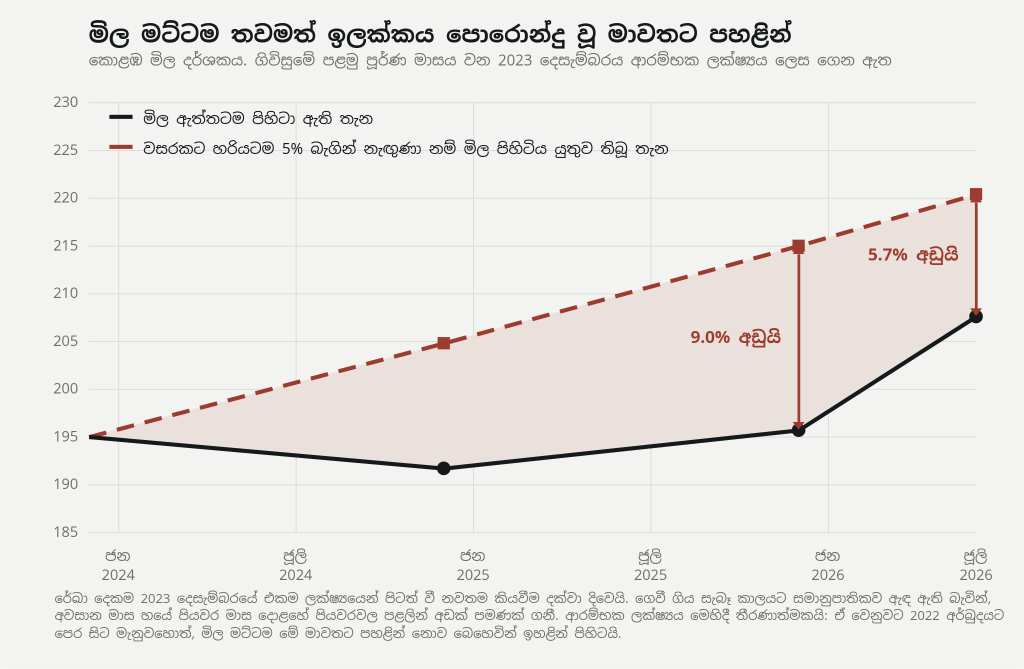
Here is a way of looking at inflation that the monthly headlines obscure. Rather than asking how fast prices rose last month, ask where the general price level would now be if the Bank had delivered exactly 5% every year since the Agreement was signed.
The answer is that prices today sit roughly 5.7% below that line, having been about 9% below it at the end of last year. Put simply: a shopping basket that should cost 220 rupees, on the promise the Bank made, costs about 208.
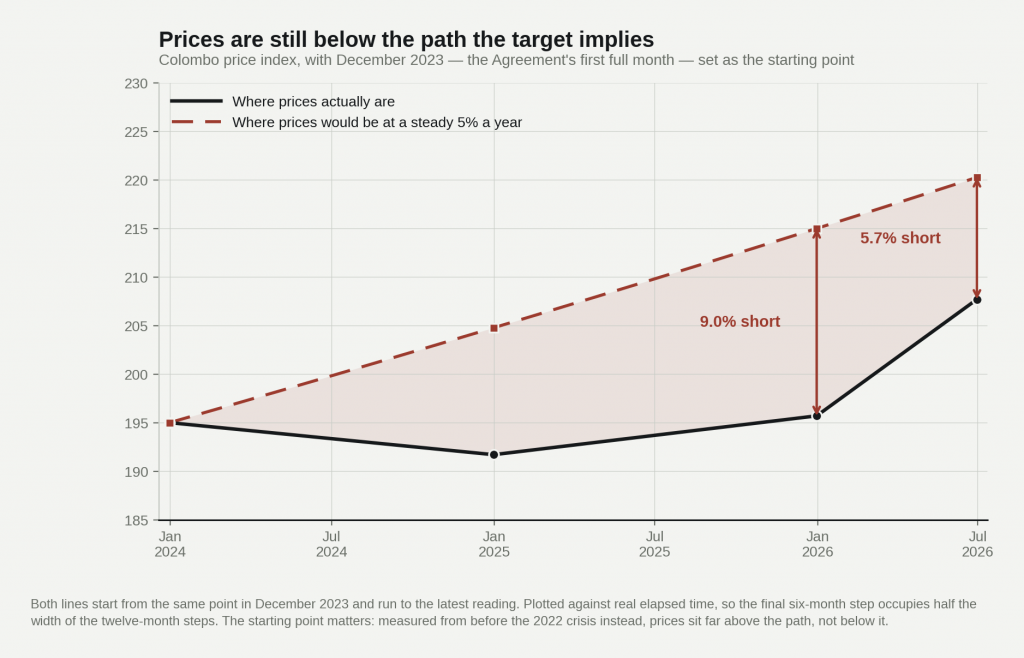
One qualification, stated openly, because the argument is weaker if we hide it. The 2023 Agreement targets a rate of inflation, not a price level. Nothing in it obliges the Bank to make up a shortfall. And the starting point does all the work: measure from before the 2022 crisis instead, and prices sit far above any 5% path, not below it.
But that is the point rather than an answer to it. A target with no stated time horizon lets the price level drift in either direction indefinitely, with no moment at which anyone is obliged to notice. Over the two years in which this drift built up, the policy rate moved by a quarter of a percentage point in total.
The Governor is right about one thing
At the July press conference the Governor was pressed on whether the Board would meet early if the war ended. His answer was that monetary policy decisions are forward-looking, that a sudden shock can move prices sharply for reasons monetary policy cannot address, and that the Board does not need to meet in response to that kind of volatility. Six scheduled reviews a year, in his view, are enough.
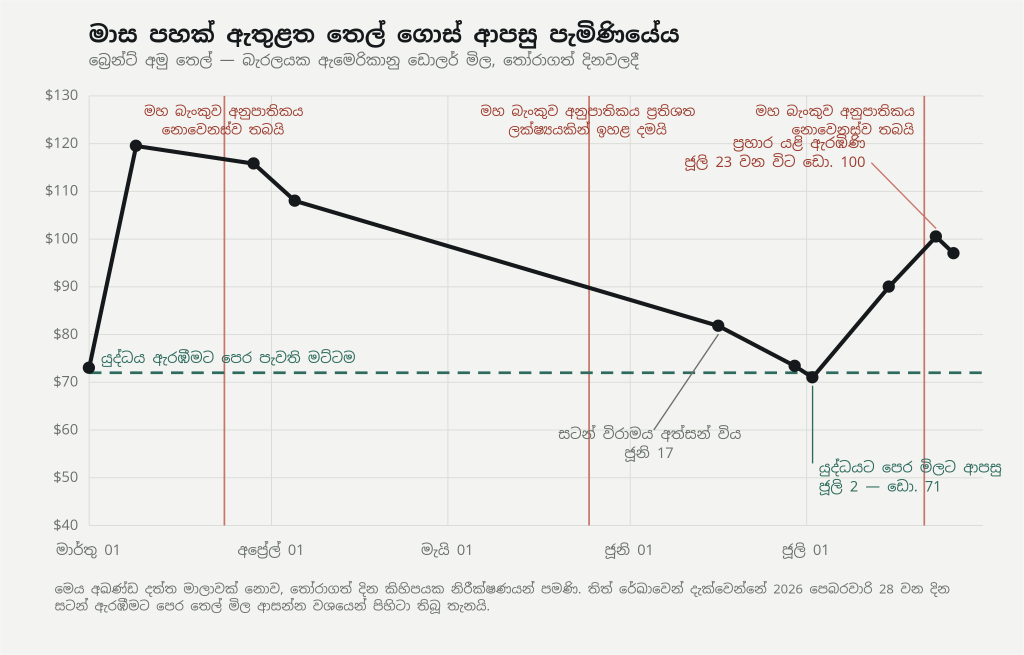
He has a strong case, and the three weeks since have made it stronger. Look at what oil actually did.
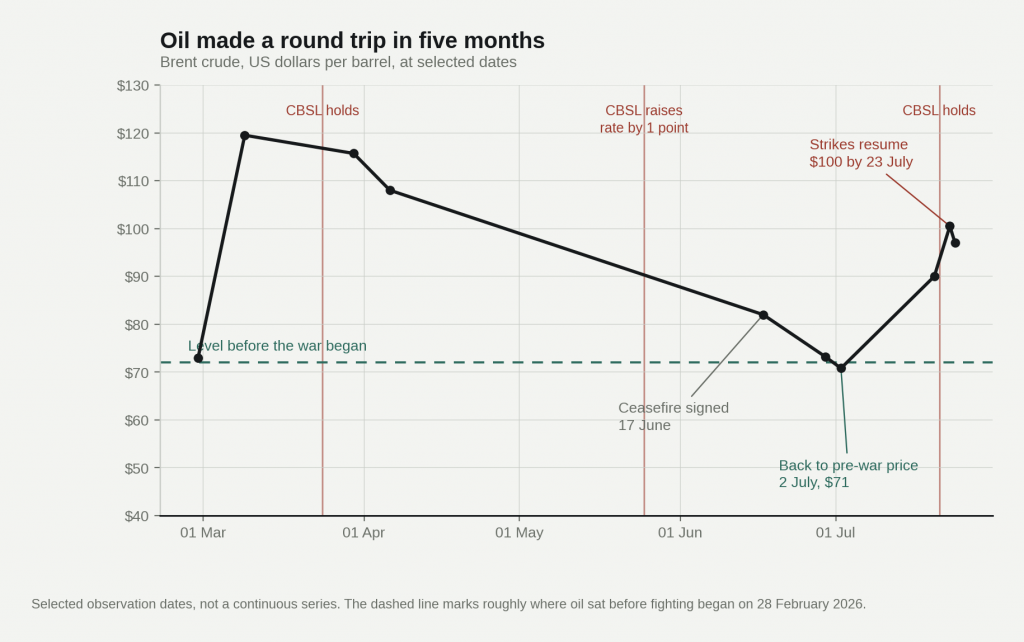
That is the textbook argument against fine-tuning, and it just ran as a live experiment. Anyone arguing for a rate cut in early July would now look reckless. The domestic fuel pricing mechanism, meanwhile, delivered part of the adjustment on its own: the state fuel corporation cut petrol and diesel prices at the end of June without any monetary decision being required.
So we accept the Governor’s position on volatility entirely. Our argument is a different one.
Standby is not the same as fine-tuning
There is a large difference between reacting to every price movement and being ready to reassess when the specific thing you cited as your reason disappears. The first is what the Governor rejected, correctly. The second is what we are asking for, and he did not address it.
Read the May statement carefully and it rests on four legs:
| What the Board cited in May | What happens if the war ends |
| Oil prices forcing sharp increases in domestic energy prices | Reverses within weeks |
| Short-term inflation expectations having risen | Reverses |
| External pressure amplified by speculative activity | Reverses |
| Domestic demand strengthening, credit growth, credit-driven imports | Persists |
Three of the four legs are war-dependent. Only one is not. A decision resting on four legs, three of which can vanish inside a month, is a decision that deserves a scheduled opportunity for review.
And note the Governor’s own test. He said the Board would meet outside the calendar if excess demand were emerging, if there were pressure on the currency, or if demand were driving inflation. Two of those three triggers are precisely what a war’s end would flip. By the criteria he himself set out, the end of the war is a candidate for reassessment, not automatically a reason to cut, but a reason to look.
Standby means the Board commits to looking, not to acting. That distinction is the whole argument, and it is why the volatility objection does not apply. Nobody is asking the Board to respond to a three-day move in Brent. They are asking it to say what it would do if the single event it named as its reason came to an end.
What the market thinks the next ten weeks hold
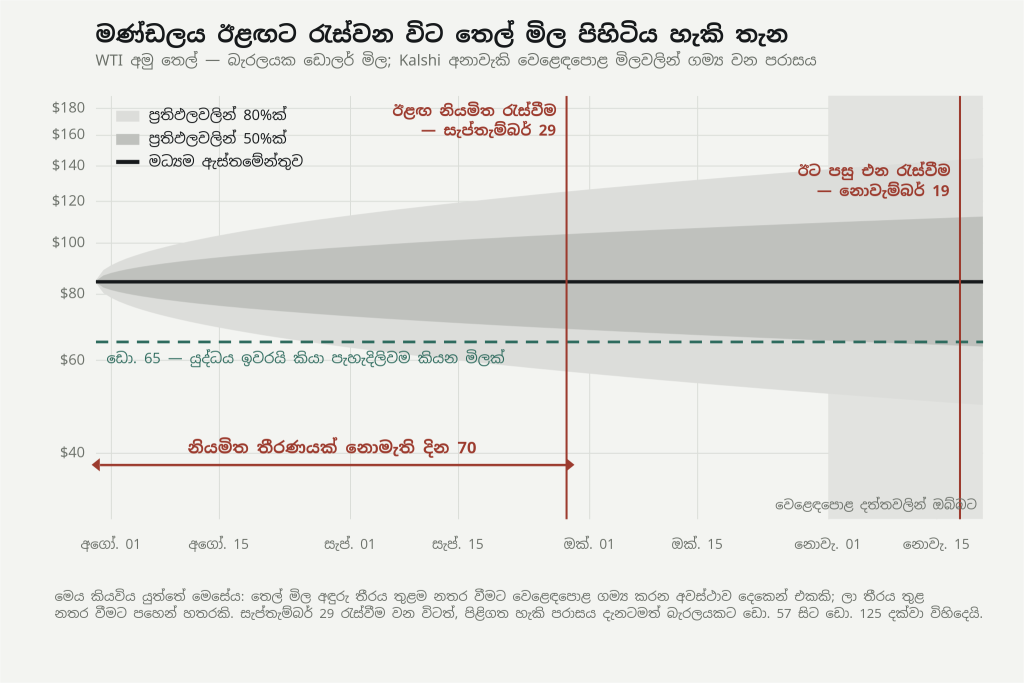
We can put numbers on this rather than speculate. Kalshi is a regulated US exchange where people trade contracts that pay out if a specific event happens. Because these contracts trade at prices between zero and one hundred, the price is readable as a probability: a contract trading at 26 implies the market thinks there is roughly a 26% chance of the event.
Two of these markets are directly relevant. One asks where US crude oil will be on 3 November. The other asks whether crude will fall to $65 a barrel, a level that would clearly signal the war premium had gone, and by when.
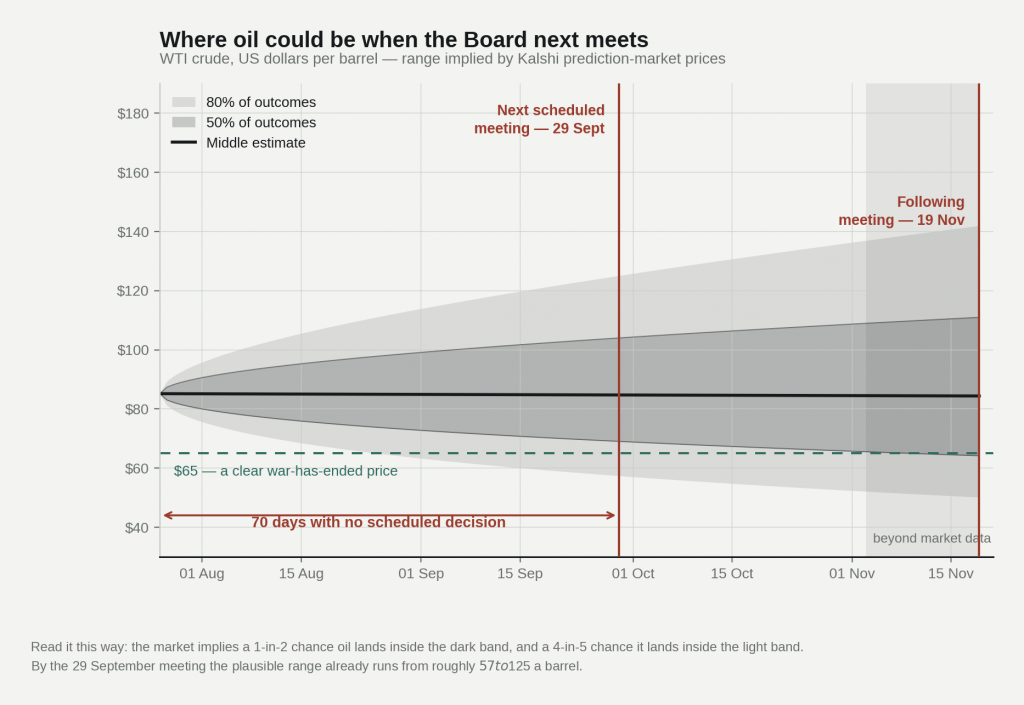
The second market makes the timing question concrete, and it also shows just how violently views have swung.
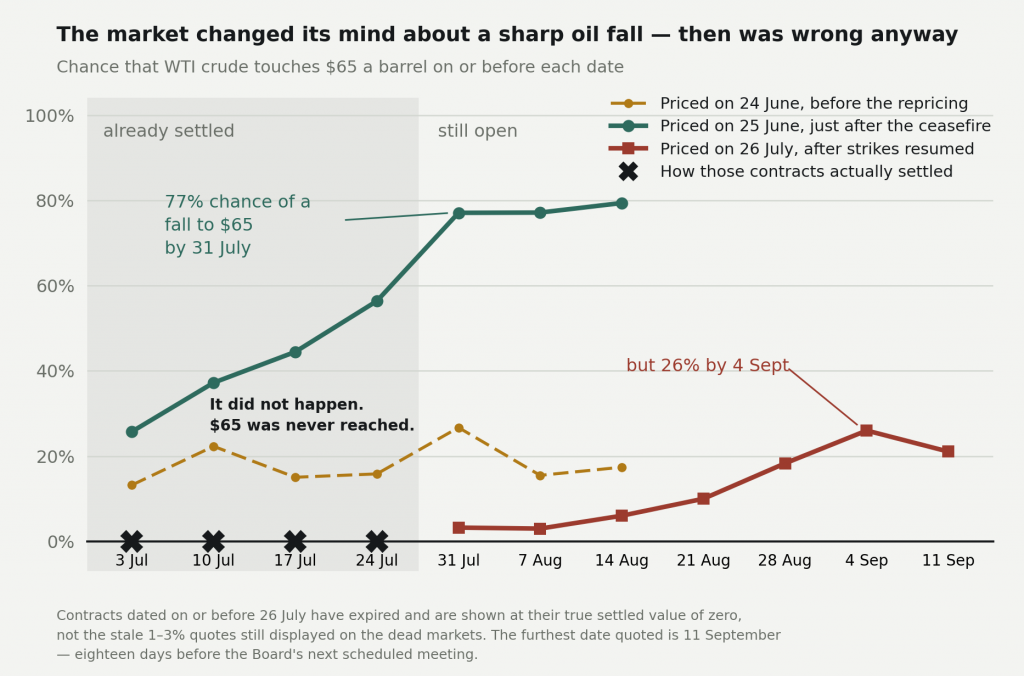
Take those two charts together and the case for standby writes itself. The market says a war-ending oil collapse is unlikely in the next month but far from remote over the next six weeks, roughly a one-in-four chance of arriving right before the September meeting, and a meaningful chance of arriving after it. That is precisely the situation in which a central bank should say in advance what it would do, rather than leaving everyone to guess.
It is also worth noticing what is not needed to make this argument. You do not need a view on how the war will end, on who will win it, or on the political calendar in any other country. You need only observe the oil price and the exchange rate, both of which the Bank watches already.
| What standby would actually look like A stated trigger and a stated deadline. “The Board will convene within ten working days of a durable ceasefire being confirmed.” One sentence. A published list of what it would examine. The landed cost of imported fuel, the exchange rate, credit growth, and short-term inflation expectations. Four indicators, named in advance, so that markets and the public can form the same view the Board will form. A conditional statement of intent. Not a promise to cut. A sentence saying what the Board judges would follow if the energy shock reverses while credit growth stays firm, and what would follow if both reverse together. A published rule for looking through supply shocks. The absence of one is why the same war could justify holding in March and raising in May without any inconsistency ever being formally admitted. |
Why the rulebook makes standby harder than it should be
The Monetary Policy Framework Agreement, the document that creates the 5% target, runs to two operative paragraphs. Its brevity is not elegance. It is the reason the Board can move in opposite directions on the same evidence without ever being caught out.
It never says over what period success is judged
The Agreement instructs the Bank to maintain inflation at 5%. It does not say whether that means each quarter, each year, or on average over three years. Every policy statement refers to stabilising inflation “over the medium term”, but that phrase appears nowhere in the signed document. The Bank chose it. In other words, the period over which the Board is held accountable is set by the Board.
It never expires and is never reviewed
The Agreement says only that it takes effect from the date of signing. There is no review date and no expiry. India, by contrast, is legally required to revisit its inflation target every five years, and did so in March 2026. Sri Lanka has run the same number since 2023 with no scheduled occasion on which anyone must ask whether 5% is still right for an economy that has changed enormously.
It has no rule for supply shocks at all
Core inflation appears in every policy statement and in none of the Agreement. There is no definition of it, and no published rule for when a price rise counts as temporary. This is exactly how the same oil shock became a reason to hold rates in March, the Board said the low starting point gave it room to absorb higher energy prices, and a reason to raise them in May.
The number the Bank is judged on is not entirely its own
This is the least discussed problem and, in our view, the most serious.
The price index the Bank is legally assessed against is compiled by the Department of Census and Statistics, which is a department of government rather than an independent statistical agency. A meaningful share of the goods in that index are priced by the government itself: electricity tariffs set through the utilities regulator, and fuel prices governed by a formula that has been suspended and reinstated more than once.
The consequence is uncomfortable and straightforward. Government decisions can move the number the Central Bank is graded on. The deflation of 2024 and 2025, when prices actually fell, was substantially produced this way, through electricity tariff cuts and falling administered fuel prices. The Bank duly wrote to Parliament in January 2025 explaining a miss that Treasury and regulatory decisions had done much to cause.
A system in which the assessed party explains results largely determined by the assessing party, measured by a statistic the assessing party produces, is not a working accountability system.
The choice of index compounds this. The Agreement hard-codes the Colombo index, which covers urban areas of one district. Changing it would require a new Gazette. Its basket of goods is weighted using spending patterns from 2021, a year of import controls, shortages and queues. The Bank is steering by a map of what households bought during the run-up to a collapse.
| Colombo index (the target) | National index | |
| Where prices are collected | Urban Colombo district | All nine provinces |
| Share of basket that is food | 28.2% | 39.2% |
| Published | Last working day of the month | About 21 days later |
| Core inflation, June 2026 | 4.0% | 5.0% |
In fairness, the national index would not obviously be a better target: because food makes up a far larger share of it, using it would formally hold the Bank responsible for even more of what it cannot control. And the Colombo index is genuinely fast, published on the last working day of the month, quicker than the United States, Europe or India. Timeliness is not the problem. The frozen 2021 basket, and the fact that changing anything requires a new Gazette, are.
Forecasts that nobody independently checks
Everything happens inside one building. The Bank’s research department produces the inflation forecasts. A committee chaired by the Governor turns them into recommendations. The Monetary Policy Board, on which two outside experts sit alongside the Governor, board members and two deputy governors, takes the decision.
Forecasting in-house is not itself a fault; every serious central bank does it. What is missing is any published outside benchmark to check those forecasts against. Brazil’s central bank collects and publishes a weekly survey of well over a hundred private institutions, so its own numbers are continuously and visibly scored against an independent consensus. India publishes a professional forecasters’ survey. Sri Lanka publishes nothing equivalent.
The gap widens when you look at expectations. Sri Lanka has no inflation-linked government bonds, bonds whose payout rises with inflation, whose price tells you directly what investors expect inflation to be. The ordinary government bond market is too thin after the debt restructuring to infer much. So the only systematic evidence on what people expect inflation to be is the Central Bank’s own survey.
Which means that every policy statement’s assurance that inflation expectations remain well anchored around the target, a claim central to every decision the Board takes, is produced by the institution the claim exonerates, and can be independently verified by nobody.
Sources. Monetary Policy Framework Agreement, Gazette Extraordinary No. 2352/20, 5 October 2023. Central Bank of Sri Lanka Monetary Policy Reviews Nos. 2, 3 and 4 of 2026, and the Policy Announcement Tracker confirming meeting dates of 29 September and 19 November 2026. Transcript of the July 2026 monetary policy press conference. CBSL Report on the Deviation of Headline Inflation from the Inflation Target, presented to Parliament 10 January 2025. Department of Census and Statistics monthly price releases. Ceylon Petroleum Corporation price revisions of 30 May and 29 June 2026. Kalshi prediction-market price histories for US crude oil, markets KXWTI-26NOV03 and KXWTIWHEN-65, data to 26 July 2026. Reserve Bank of India, five-yearly target notification of 25 March 2026. Banco Central do Brasil continuous inflation target framework, in force from January 2025.
මැයි මාසයේ දී මහ බැංකුව පොලී අනුපාතික ඉහළ දැමුවේ, යුද්ධයක් නිසා තෙල් මිල ඉහළ ගිය බැවිනි. එම යුද්ධය අවසන් වුවහොත් අනුපාතික ඉහළ දැමීමට තිබූ හේතුවම අහෝසි වී යයි. එහෙත් ඊළඟ නියමිත රැස්වීම තිබෙන්නේ සැප්තැම්බර් අග දී ය.
මහනුවර කුමාරයා
| තර්කය, කෙටියෙන් මැයි 25 වන දින මුදල් ප්රතිපත්ති මණ්ඩලය — එනම් රටේ පොලී අනුපාතික තීරණය කරන මහ බැංකුවේ ඉහළම මණ්ඩලය — තම පොලී අනුපාතිකය පූර්ණ ප්රතිශත ලක්ෂ්යයකින් ඉහළ දැමීය. (ප්රතිශත ලක්ෂ්යයක් යනු අනුපාතිකයක් මනින ඒකකයයි; 7.75% සිට 8.75% දක්වා යාම ප්රතිශත ලක්ෂ්යයක නැඟීමකි.) ඒ සඳහා එය දුන් හේතුව වූයේ මැදපෙරදිග යුද්ධය නිසා ඇති වූ තෙල් මිල කම්පනයත්, ආර්ථිකය තුළ වියදම් කිරීම යළි ඉහළ යමින් තිබෙන බවට පෙනුණු ලකුණුත් ය. ජූලි 21 වන දින එය අනුපාතිකය නොවෙනස්ව තැබීය. ඊළඟ නියමිත රැස්වීම සැප්තැම්බර් 29 වන දින ය. එනම් දින හැත්තෑවක පරතරයකි. එම පරතරය ඇතුළත, දැනටමත් වරක් — ජූනි මාසයේ දී — අවසන් වී යළි ඇරඹුණු යුද්ධයක් තිබේ. එය නැවතත්, මෙවර හරි හැටියටම, අවසන් වුවහොත් තෙල් මිල පහත වැටේ; රුපියල මත ඇති පීඩනය ලිහිල් වේ; මැයි මාසයේ නැඟීම පිටුපස තිබූ තර්කයෙන් වැඩි කොටසක් තවදුරටත් අදාළ නොවේ. වත්මන් දින දර්ශනය යටතේ නම්, සැප්තැම්බර් අග වන තුරු මහ බැංකුවේ කිසිවකු එය නිල වශයෙන් දැක බලා ගැනීමට නියමිත නැත. මෙම ලිපිය තර්ක කරන්නේ මණ්ඩලය පොලී අනුපාතික අඩු කළ යුතු බව නොවේ. එය තර්ක කරන්නේ ඊට වඩා පටු — එහෙත් අප සිතන පරිදි ප්රතික්ෂේප කිරීමට ඊට වඩා අපහසු — දෙයකි: තමන් සූදානම් තත්ත්වයේ සිටින බව මණ්ඩලය ප්රසිද්ධියේ ප්රකාශ කළ යුතුය. එනම්, කල් පවත්නා සටන් විරාමයක් සිදු වුවහොත් නියමිත දින ගණනක් ඇතුළත රැස්වන බවත්, එවිට තමන් බලන කරුණු කිහිපය කල් ඇතිව ප්රසිද්ධ කරන බවත් ය. සූදානමින් සිටීමට වියදමක් නැත. සූදානමින් නොසිටීමේ වියදම නම්, තවදුරටත් නොපවතින ලෝකයකට ගැළපෙන ලෙස සකසන ලද ප්රතිපත්තියක් දින හැත්තෑවක් දක්වා එසේම තබා ගැනීමයි. |
මේ වසරේ දෙවන කාර්තුවේ දී ශ්රී ලංකාවේ උද්ධමනය — එනම් පොදුවේ භාණ්ඩ හා සේවාවල මිල වසරක් තුළ ඉහළ යන වේගය — රාමු ගිවිසුම අත්සන් කළ දා පටන් පළමු වතාවට 5% දක්වා ආපසු පැමිණියේය. මහ බැංකුව මෙය හඳුන්වා ඇත්තේ ප්රතිපත්තිය ක්රියාත්මක වීමක් ලෙසය. වඩාත් නිවැරදි විස්තරය නම්, මැදපෙරදිග යුද්ධයක් පැමිණ එම කාර්යය කලින්ම කර දුන් බවයි.
මෙය අපගේ අනුමානයක් නොවේ. ජූලි මාසයේ පැවති ප්රවෘත්ති සාකච්ඡාවේ දී අපගේ අධිපතිතුමා නිල වශයෙන්ම කී දෙයයි. සැප්තැම්බරයට පෙර මණ්ඩලය නැවත රැස් නොවන්නේ මන්දැයි ඇසූ විට, යුද්ධය ඇරඹීමට පෙර බැංකුවේම පුරෝකථනවලට අනුව උද්ධමනය 5% ඉලක්කයට එළඹෙන්නේ 2026 අග හෝ 2027 මුල දී බවත්, එය එසේ වන්නේ ඒ වන විට ක්රමයෙන් ගොඩනැඟෙන ඉල්ලුම් පීඩන නිසා බවත්, යුද්ධය එම නැඟීම කලින් ගෙන ආ බවත් ඔහු පැහැදිලි කළේය.
බැංකුවේ ප්රකාශිත නිවේදනවලද මෙයම, ටිකක් නිහඬව, කියැවේ. මාර්තු මාසයේ දී එය තම පුරෝකථනය සංශෝධනය කරමින්, උද්ධමනය 5%ට එළඹෙනු ඇතැයි දැන් අපේක්ෂා කරන්නේ 2026 දෙවන කාර්තුවේ දී බවත් — එනම් කලින් සිතුවාට වඩා කලින් බවත් — සඳහන් කළේය. ඊට හේතුව තෙල් ය.
එබැවින් මෙම විවේචනයේ අවංක අනුවාදය නම්, ඉලක්කය කිසිසේත් සපුරා ගැනීමට නොහැකි වන්නට තිබුණි යන්න නොවේ. එය නම්, ඉලක්කය බැංකුවේම පුරෝකථනයට වඩා කාර්තු දෙකක් තුනක් කලින් පැමිණි බවත්, එය ගෙන ආවේ බැංකුව පුරෝකථනය නොකළ, බලපෑමක්ද නොකළ සැපයුම් කම්පනයක් — එනම් භාණ්ඩයක් සැපයෙන ප්රමාණයේ හදිසි වෙනසකින් ඇති වන මිල කම්පනයක් — බවත් ය. කාලගුණය වෙනස් වූ නිසා ගමනාන්තයට ළඟා වූ රාමුවක්, තමන්ට හසුරුවන්නට පුළුවන් බව තවම පෙන්වා නැත.
එම පිළිගැනීම තුළම ඊට වඩා තියුණු කරුණක් සැඟවී තිබේ. යුද්ධයට පෙර පැවති පුරෝකථනයට අනුව, ප්රතිපත්ති පොලී අනුපාතිකය 7.75% මට්ටමේ වසරකට වැඩි කලක් නොවෙනස්ව තිබිය දී උද්ධමනය 2026 අග වන විට 5% දක්වා ආපසු එනවා නම්, එවිට බැංකුව සාර්ථකත්වය පුරෝකථනය කරමින් සිටියේ පොලී අනුපාතික කිසිසේත් ඉහළ නොදමා ය. යුද්ධය එළඹීමේ දිනය ඉදිරියට ඇදගෙන ආ අතර, ඉන් පසුව බැංකුව අනුපාතිකය පූර්ණ ලක්ෂ්යයකින් ඉහළ දැමීය. එම නැඟීම ප්රතිචාර දැක්වූයේ කාලසටහනට මිස ඉල්ලුමේ කතාවට නොවේ; ඉල්ලුමේ කතාව දැනටමත් පුරෝකථනය තුළම තිබුණි.
මිල මට්ටම තවමත් පොරොන්දුව ඉඟි කළ මාවතට පහළින්
මාසික ශීර්ෂ පාඨ වසන් කරන දෙය පෙනෙන ලෙස උද්ධමනය දෙස බලන ක්රමයක් මෙන්න. පසුගිය මාසයේ මිල කෙතරම් වේගයෙන් ඉහළ ගියේ ද යනු වෙනුවට, ගිවිසුම අත්සන් කළ දා පටන් බැංකුව හරියටම වසරකට 5% බැගින් ලබා දී තිබුණේ නම් අද පොදු මිල මට්ටම කොහේ තිබෙන්නට තිබුණි ද යනු අසන්න.
පිළිතුර නම්, අද මිල එම රේඛාවට වඩා 5.7%ක් පමණ පහළින් පිහිටා ඇති බවත්, පසුගිය වසර අවසානයේ දී එය 9%ක් පමණ පහළින් තිබූ බවත් ය. සරලව කිවහොත්: බැංකුව දුන් පොරොන්දුවට අනුව රුපියල් 220ක් විය යුතු බඩු මල්ලක් අද වැය වන්නේ රුපියල් 208ක් පමණි.
එක් සීමාවක් — එය සඟවා තැබුවහොත් තර්කය දුර්වල වන බැවින් — විවෘතව කියමු. 2023 ගිවිසුම ඉලක්ක කරන්නේ උද්ධමනයේ වේගය මිස මිල මට්ටම නොවේ. අඩුවක් පසුව පියවා ගැනීමට බැංකුවට එහි කිසිදු බැඳීමක් නැත. තවද ආරම්භක ලක්ෂ්යය මුළු කාර්යයම කරයි: ඒ වෙනුවට 2022 අර්බුදයට පෙර සිට මැනුවහොත්, මිල මට්ටම කිසිදු 5% මාවතකට යටින් නොව එයට වඩා බෙහෙවින් ඉහළින් පිහිටයි.
එහෙත් එය මෙම තර්කයට පිළිතුරක් නොව, තර්කයේම කරුණයි. නිශ්චිත කාල සීමාවක් ප්රකාශ නොකරන ලද ඉලක්කයක් නිසා, මිල මට්ටමට දෙපැත්තටම අනිශ්චිත කාලයක් ගසාගෙන යා හැකි වන අතර, එය දැකීමට කිසිවකු බැඳී සිටින මොහොතක් කිසිදා නොපැමිණේ. මෙම ගසාගෙන යාම ගොඩනැඟුණු වසර දෙක තුළ, ප්රතිපත්ති පොලී අනුපාතිකය සියල්ල එකතු කළ විට වෙනස් වූයේ ප්රතිශත ලක්ෂ්යයෙන් හතරෙන් පංගුවකින් පමණි.
එක් කරුණක් ගැන අධිපතිතුමා නිවැරදිය
ජූලි ප්රවෘත්ති සාකච්ඡාවේ දී, යුද්ධය අවසන් වුවහොත් මණ්ඩලය කලින් රැස්වේ ද යන්න ගැන අධිපතිතුමාගෙන් තදින් විමසන ලදී. ඔහුගේ පිළිතුර වූයේ මුදල් ප්රතිපත්ති තීරණ ගනු ලබන්නේ ඉදිරිය බලාගෙන බවත්, හදිසි කම්පනයකට මුදල් ප්රතිපත්තියෙන් විසඳිය නොහැකි හේතූන් නිසා මිල තියුණු ලෙස චලනය කළ හැකි බවත්, එවැනි උච්චාවචනයකට ප්රතිචාර වශයෙන් මණ්ඩලය රැස්විය යුතු නොවන බවත් ය. වසරකට නියමිත සමාලෝචන හයක් ඔහුගේ මතය අනුව ප්රමාණවත් ය.
ඔහුට ප්රබල නඩුවක් තිබේ; ඉන් පසු ගත වූ සති තුන එය තවත් ප්රබල කර ඇත. තෙල් ඇත්තටම කළේ කුමක් ද යන්න බලන්න.
සියුම් ලෙස ප්රතිපත්තිය සකස් කිරීමට එරෙහි පෙළපොත් තර්කය එයයි; එය දැන් සජීවී අත්හදා බැලීමක් ලෙසම දිග හැරුණි. ජූලි මුල දී පොලී අනුපාතික කැපීමට තර්ක කළ ඕනෑම කෙනෙක් අද පෙනෙනු ඇත්තේ නොසැලකිලිමත් අයෙකු ලෙසය. මේ අතර, දේශීය ඉන්ධන මිල සූත්රය එම ගැළපීමේ කොටසක් තමන්ගේම ලෙස ලබා දුන්නේය: ජූනි අග දී රාජ්ය ඉන්ධන සංස්ථාව පෙට්රල් හා ඩීසල් මිල අඩු කළේ මුදල් ප්රතිපත්ති තීරණයක් අවශ්ය නොවී ය.
එබැවින් උච්චාවචනය සම්බන්ධයෙන් අධිපතිතුමාගේ ස්ථාවරය අපි සම්පූර්ණයෙන්ම පිළිගනිමු. අපගේ තර්කය වෙනස් එකකි.
සූදානමින් සිටීම හා සියුම් ලෙස සකස් කිරීම එකක් නොවේ
සෑම මිල චලනයකටම ප්රතිචාර දැක්වීම සහ ඔබ ඔබේ හේතුව ලෙස නම් කළ නිශ්චිත දෙයම අතුරුදන් වූ විට යළි තක්සේරු කිරීමට සූදානමින් සිටීම අතර විශාල වෙනසක් ඇත. පළමුවැන්න අධිපතිතුමා ප්රතික්ෂේප කළේ නිවැරදිවම ය. දෙවැන්න අප ඉල්ලා සිටින දෙය වන අතර, ඒ ගැන ඔහු කතා කළේ නැත.
මැයි නිවේදනය සැලකිල්ලෙන් කියවා බලන්න; එය සිටගෙන ඇත්තේ කකුල් හතරක් මතය:
| මණ්ඩලය මැයි මාසයේ දක්වූ හේතුව | යුද්ධය අවසන් වුවහොත් කුමක් වේ ද |
| තෙල් මිල නිසා දේශීය බලශක්ති මිල තියුණු ලෙස ඉහළ යාම | සති කිහිපයක් ඇතුළත ආපසු හැරේ |
| කෙටි කාලීන උද්ධමන අපේක්ෂා ඉහළ ගොස් තිබීම | ආපසු හැරේ |
| සමපේක්ෂන ක්රියාකාරකම් නිසා තීව්ර වූ බාහිර පීඩනය | ආපසු හැරේ |
| දේශීය ඉල්ලුම ශක්තිමත් වීම, ණය වර්ධනය, ණය මත පදනම් වූ ආනයන | දිගටම පවතී |
කකුල් හතරෙන් තුනක්ම යුද්ධය මත රඳා පවතී. එකක් පමණක් එසේ නොවේ. මාසයක් ඇතුළත අතුරුදන් විය හැකි කකුල් තුනක් ඇතුළු කකුල් හතරක් මත සිටගෙන සිටින තීරණයක්, යළි සමාලෝචනය කිරීමට නියමිත අවස්ථාවක් ලැබිය යුතු තීරණයකි.
තවද අධිපතිතුමාගේම පරීක්ෂණය සලකා බලන්න. අතිරික්ත ඉල්ලුමක් මතු වන්නේ නම්, මුදල් ඒකකය මත පීඩනයක් ඇත්නම්, හෝ ඉල්ලුම උද්ධමනය තල්ලු කරන්නේ නම්, දින දර්ශනයෙන් පිටත මණ්ඩලය රැස්වන බව ඔහු කීවේය. එම ප්රේරක තුනෙන් දෙකක්ම යුද්ධයක අවසානය හරියටම පෙරළන දේවල් ය. ඔහුම දක්වා ඇති නිර්ණායක අනුව බලන විට, යුද්ධයේ අවසානය යළි තක්සේරු කිරීමකට සුදුසුකම් ලබන අවස්ථාවකි — ස්වයංක්රීයව අනුපාතික කැපීමට හේතුවක් නොව, බැලීමට හේතුවකි.
සූදානමින් සිටීම යනු මණ්ඩලය බැලීමට බැඳී සිටීම මිස ක්රියා කිරීමට බැඳී සිටීම නොවේ. එම වෙනස මුළු තර්කයම වන අතර, උච්චාවචනය පිළිබඳ විරෝධය මෙයට අදාළ නොවන්නේ ද එබැවිනි. බ්රෙන්ට් තෙල් මිලේ දින තුනක චලනයකට ප්රතිචාර දක්වන ලෙස කිසිවෙක් මණ්ඩලයෙන් ඉල්ලා නැත. ඔවුන් ඉල්ලා සිටින්නේ, තමන් තම හේතුව ලෙස නම් කළ එකම සිදුවීම අවසන් වුවහොත් තමන් කරන්නේ කුමක් ද යන්න ප්රකාශ කරන ලෙසයි.
ඉදිරි සති දහය තුළ සිදුවනු ඇතැයි වෙළෙඳපොළ සිතන දෙය
මේ ගැන අනුමාන කරනවා වෙනුවට අපට සංඛ්යා දැක්විය හැකිය. Kalshi යනු නිශ්චිත සිදුවීමක් සිදු වුවහොත් මුදල් ගෙවන කොන්ත්රාත්තු මිනිසුන් හුවමාරු කර ගන්නා, ඇමෙරිකාවේ නියාමනය කරන ලද වෙළෙඳපොළකි. එම කොන්ත්රාත්තු බිංදුව හා සියය අතර මිලකට හුවමාරු වන බැවින්, එම මිලම සම්භාවිතාවක් ලෙස කියවිය හැකිය: 26කට හුවමාරු වන කොන්ත්රාත්තුවක් අදහස් කරන්නේ එම සිදුවීම සිදුවීමට ආසන්න වශයෙන් 26%ක අවස්ථාවක් ඇතැයි වෙළෙඳපොළ සිතන බවයි.
මෙයින් වෙළෙඳපොළවල් දෙකක් සෘජුවම අදාළ වේ. එකක් අසන්නේ නොවැම්බර් 3 වන දින ඇමෙරිකානු අමු තෙල් මිල කොහේ තිබේ ද යන්නයි. අනෙක අසන්නේ අමු තෙල් බැරලයක් ඩොලර් 65 දක්වා — යුද්ධය නිසා එකතු වූ අමතර මිල අහෝසි වී ඇති බව පැහැදිලිවම කියන මට්ටමකට — පහත වැටේ ද, එසේ නම් කවර දිනකට පෙර ද යන්නයි.
දෙවන වෙළෙඳපොළ කාලය පිළිබඳ ප්රශ්නය සංයුක්ත කරන අතර, මත කෙතරම් දරුණු ලෙස පෙරළී ඇත් ද යන්නද පෙන්වයි.
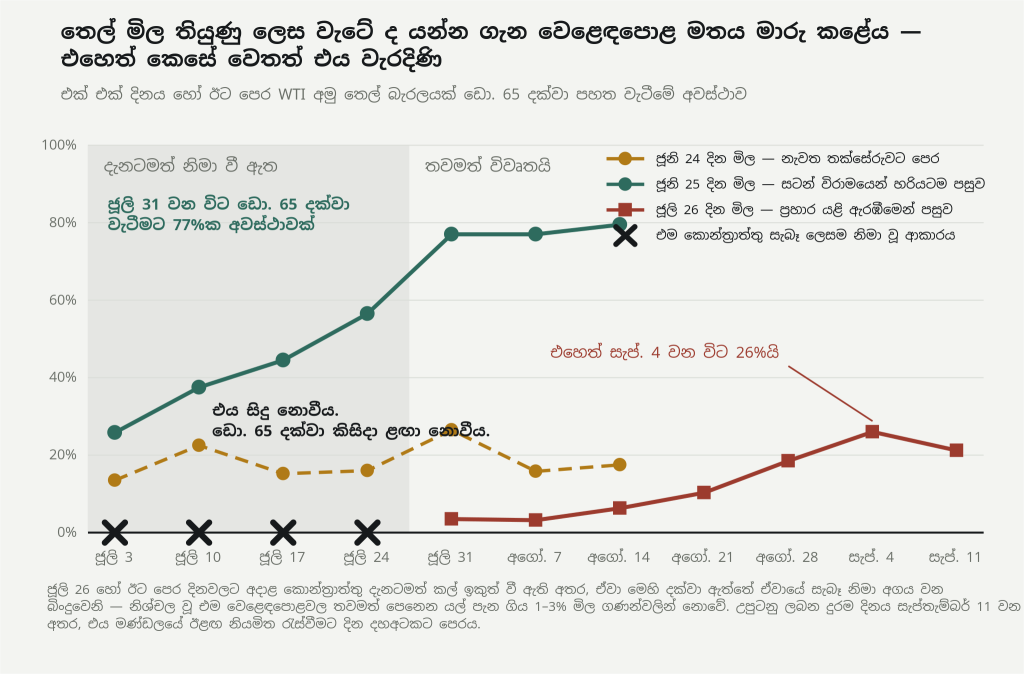
එම සටහන් දෙක එකට ගත් විට, සූදානමින් සිටීම සඳහා වන නඩුව තනිවම ලියැවේ. යුද්ධය අවසන් කරන තෙල් මිල කඩා වැටීමක් ඉදිරි මාසය තුළ අවිශ්වාස සහගත බවත්, එහෙත් ඉදිරි සති හය තුළ කිසිසේත් දුරස්ථ නොවන බවත් — සැප්තැම්බර් රැස්වීමට හරියටම පෙර පැමිණීමට ආසන්න වශයෙන් හතරෙන් එකක අවස්ථාවක් සහ ඉන් පසුව පැමිණීමට සැලකිය යුතු අවස්ථාවක් ඇති බවත් — වෙළෙඳපොළ කියයි. මහ බැංකුවක් තමන් කරන්නේ කුමක් ද යන්න කල් ඇතිව ප්රකාශ කළ යුත්තේ, සියල්ලන් අනුමාන කිරීමට ඉඩ හැරීම වෙනුවට, හරියටම එවැනි තත්ත්වයක දී ය.
මෙම තර්කය ගොඩනැඟීමට අවශ්ය නොවන දෙය කුමක් ද යන්නද සැලකිල්ලට ගැනීම වටී. යුද්ධය අවසන් වන ආකාරය ගැන, එය දිනන්නේ කවුරුන් ද යන්න ගැන, හෝ වෙනත් රටක දේශපාලන දින දර්ශනය ගැන ඔබට කිසිදු මතයක් අවශ්ය නොවේ. ඔබට අවශ්ය වන්නේ තෙල් මිලත් විනිමය අනුපාතයත් නිරීක්ෂණය කිරීම පමණි; බැංකුව දැනටමත් ඒ දෙකම නිරීක්ෂණය කරයි.
| සූදානම් තත්ත්වය ඇත්තටම පෙනෙන්නේ කෙසේ ද ප්රකාශිත ප්රේරකයක් හා ප්රකාශිත කාල සීමාවක්. “කල් පවත්නා සටන් විරාමයක් තහවුරු වී වැඩ කරන දින දහයක් ඇතුළත මණ්ඩලය රැස්වනු ඇත.” එක් වාක්යයකි. තමන් පරීක්ෂා කරන දේ පිළිබඳ ප්රසිද්ධ ලැයිස්තුවක්. ආනයනික ඉන්ධන මෙරටට ගොඩබාන විට ඒවාට වැය වන මුළු පිරිවැය, විනිමය අනුපාතය, ණය වර්ධනය, සහ කෙටි කාලීන උද්ධමන අපේක්ෂා. දර්ශක හතරක්, කල් ඇතිව නම් කර ඇත; එවිට වෙළෙඳපොළවලටත් මහජනතාවටත් මණ්ඩලය සාදන මතයම සෑදිය හැකිය. කොන්දේසි සහිත අභිප්රාය ප්රකාශයක්. අනුපාතික කපන බවට පොරොන්දුවක් නොවේ. ණය වර්ධනය ශක්තිමත්ව පවතිද්දී බලශක්ති කම්පනය ආපසු හැරුණහොත් කුමක් සිදු වනු ඇතැයි මණ්ඩලය සලකන්නේ ද, සහ දෙකම එකවර ආපසු හැරුණහොත් කුමක් සිදු වනු ඇත් ද යන්න පවසන එක් වාක්යයකි. සැපයුම් කම්පන පසෙකින් තබා බැලීම සඳහා ප්රසිද්ධ නීතියක්. එවැන්නක් නොමැති වීම නිසාය, කිසිදු පරස්පරයක් නිල වශයෙන් පිළිගැනීමකින් තොරව, එකම යුද්ධය මාර්තුවේ දී අනුපාතික නොවෙනස්ව තැබීමටත් මැයි මාසයේ දී ඒවා ඉහළ දැමීමටත් හේතුවක් විය හැකි වූයේ. |
නීති පොත සූදානම් වීම විය යුතුවාට වඩා අපහසු කරන්නේ ඇයි
5% ඉලක්කය නිර්මාණය කරන ලේඛනය වන මුදල් ප්රතිපත්ති රාමු ගිවිසුම, ක්රියාකාරී ඡේද දෙකකට සීමා වේ. එහි කෙටිකම අලංකාරයක් නොවේ. එකම සාක්ෂිය මත මණ්ඩලයට ප්රතිවිරුද්ධ දිශාවලට ගමන් කළ හැකි වන්නේත්, කිසිදා අතටම හසු නොවන්නේත් ඒ නිසාය.
සාර්ථකත්වය විනිශ්චය කරන කාල පරාසය එහි කිසිසේත් සඳහන් නොවේ
ගිවිසුම බැංකුවට උපදෙස් දෙන්නේ උද්ධමනය 5%ක් ලෙස පවත්වා ගන්නා ලෙසයි. එයින් අදහස් වන්නේ එක් එක් කාර්තුවේ ද, එක් එක් වසරේ ද, නැතහොත් වසර තුනක් පුරා සාමාන්යයක් ලෙස ද යන්න එහි සඳහන් නොවේ. සෑම ප්රතිපත්ති නිවේදනයක්ම “මධ්ය කාලීනව” උද්ධමනය ස්ථාවර කිරීම ගැන කියයි; එහෙත් එම වදන අත්සන් කරන ලද ලේඛනයේ කිසිම තැනක නැත. එය තෝරාගත්තේ බැංකුවයි. වෙනත් වචනවලින් කිවහොත්, මණ්ඩලය වගකිව යුතු වන කාල පරාසය තීරණය කරන්නේ මණ්ඩලයමය.
එය කිසිදා කල් ඉකුත් නොවේ; කිසිදා සමාලෝචනය නොවේ
ගිවිසුම කියන එකම දෙය නම් එය අත්සන් කළ දින සිට ක්රියාත්මක වන බවයි. සමාලෝචන දිනයක් නැත; කල් ඉකුත් වීමක්ද නැත. ඊට වෙනස්ව, ඉන්දියාව නීතියෙන් බැඳී සිටින්නේ සෑම වසර පහකට වරක්ම තම උද්ධමන ඉලක්කය යළි සලකා බැලීමට වන අතර, 2026 මාර්තුවේ දී එසේ කළේය. ශ්රී ලංකාව 2023 සිට එකම සංඛ්යාව ක්රියාත්මක කර ඇති අතර, දැවැන්ත ලෙස වෙනස් වී ඇති ආර්ථිකයකට 5% තවමත් නිවැරදි ද යන්න කිසිවකු ඇසිය යුතුම නියමිත අවස්ථාවක් නොමැත.
සැපයුම් කම්පන සඳහා එහි කිසිදු නීතියක් නැත
මූලික උද්ධමනය — එනම් තෙල් හා ආහාර වැනි ඉතා විචල්ය අයිතම ඉවත් කළ පසු ඉතිරි වන යටිතල උද්ධමනය — සෑම ප්රතිපත්ති නිවේදනයකම දිස්වන අතර ගිවිසුමේ කිසිම තැනක නොපෙනේ. එයට නිර්වචනයක් නැත; මිල ඉහළ යාමක් තාවකාලික ලෙස ගණන් ගන්නේ කවර විටක ද යන්න පිළිබඳ ප්රසිද්ධ නීතියක්ද නැත. එකම තෙල් කම්පනය මාර්තුවේ දී අනුපාතික නොවෙනස්ව තැබීමට හේතුවක් වී — ආරම්භක මට්ටම පහළ බැවින් ඉහළ බලශක්ති මිල උරාගැනීමට ඉඩ ඇති බව එවිට මණ්ඩලය කීවේය — මැයි මාසයේ දී ඒවා ඉහළ දැමීමට හේතුවක් වූයේ හරියටම මේ ආකාරයෙනි.
බැංකුව විනිශ්චය කරනු ලබන සංඛ්යාව සම්පූර්ණයෙන්ම එහිම දෙයක් නොවේ
මෙය අවම වශයෙන් සාකච්ඡාවට ලක් වන ගැටලුව වන අතර, අපගේ මතය අනුව බරපතළම එකද වේ.
බැංකුව නීතිමය වශයෙන් තක්සේරු කරනු ලබන මිල දර්ශකය සම්පාදනය කරන්නේ ජන ලේඛන හා සංඛ්යාලේඛන දෙපාර්තමේන්තුව වන අතර, එය ස්වාධීන සංඛ්යාලේඛන ආයතනයක් නොව රජයේ දෙපාර්තමේන්තුවකි. එම දර්ශකයේ ඇති භාණ්ඩවලින් සැලකිය යුතු කොටසක මිල නියම කරන්නේ රජයම ය: උපයෝගිතා නියාමන කොමිසම හරහා තීරණය වන විදුලි ගාස්තු, සහ එක් වරකට වඩා අත්හිටුවා යළි ක්රියාත්මක කර ඇති සූත්රයකින් පාලනය වන ඉන්ධන මිල.
ප්රතිඵලය අපහසුතාවට පත් කරන අතරම සරලය. රජයේ තීරණවලට, මහ බැංකුවට ලකුණු දෙනු ලබන එම සංඛ්යාවම චලනය කළ හැකිය. මිල ඇත්තටම පහත වැටුණු 2024 හා 2025 වසරවල අවධමනය — එනම් මිල ඉහළ යනවා වෙනුවට පහත වැටීම — බොහෝ දුරට නිපදවුණේ මේ ආකාරයෙනි; විදුලි ගාස්තු කැපීම් හා පහත වැටෙන පාලිත ඉන්ධන මිල හරහාය. ඒ අනුව බැංකුව 2025 ජනවාරියේ දී පාර්ලිමේන්තුවට නිසි ලෙස ලිපියක් යවා, භාණ්ඩාගාරයේ හා නියාමන තීරණවලින් බොහෝ දුරට ඇති කරන ලද ඉලක්ක ගැලවීමක් පැහැදිලි කළේය.
තක්සේරු කරන පාර්ශ්වය විසින්ම බොහෝ දුරට තීරණය කරන ලද ප්රතිඵල, තක්සේරු කරන පාර්ශ්වයම නිපදවන සංඛ්යාලේඛනයකින් මනිමින්, තක්සේරු කරනු ලබන පාර්ශ්වය පැහැදිලි කරන ක්රමයක් ක්රියාකාරී වගවීමේ ක්රමයක් නොවේ.
දර්ශකය තෝරාගැනීම මෙය තවත් උග්ර කරයි. ගිවිසුමේ කොළඹ දර්ශකය ස්ථිර ලෙසම ලියා ඇති අතර, එය ආවරණය කරන්නේ එක් දිස්ත්රික්කයක නාගරික ප්රදේශ පමණි. එය වෙනස් කිරීමට නව ගැසට් නිවේදනයක් අවශ්ය වේ. එහි භාණ්ඩ මල්ලට බර තබා ඇත්තේ 2021 වසරේ වියදම් රටාවලට අනුව ය — එය ආනයන පාලන, හිඟකම් හා පෝලිම්වල වසරකි. බැංකුව රිය පදවමින් සිටින්නේ, කඩා වැටීමකට යන ගමනේ දී ගෘහස්ථයන් මිල දී ගත් දෙයේ සිතියමක් අනුව ය.
| කොළඹ දර්ශකය (ඉලක්කය) | ජාතික දර්ශකය | |
| මිල එකතු කරන ස්ථාන | කොළඹ දිස්ත්රික්කයේ නාගරික ප්රදේශ | පළාත් නවයම |
| භාණ්ඩ මල්ලෙන් ආහාරවල කොටස | 28.2% | 39.2% |
| ප්රකාශයට පත් කරන්නේ | මාසයේ අවසන් වැඩ කරන දින | දින 21ක් පමණ පසුව |
| මූලික උද්ධමනය, 2026 ජූනි | 4.0% | 5.0% |
සාධාරණව කිවහොත්, ජාතික දර්ශකය පැහැදිලිවම වඩා හොඳ ඉලක්කයක් වන්නේ නැත: එහි ආහාරවල කොටස බෙහෙවින් විශාල බැවින්, එය භාවිත කිරීමෙන් සිදු වන්නේ බැංකුවට පාලනය කළ නොහැකි දෙයින් තවත් වැඩි කොටසකට එය නිල වශයෙන් වගකිව යුතු කිරීමයි. තවද කොළඹ දර්ශකය සැබැවින්ම වේගවත් ය: එය මාසයේ අවසන් වැඩ කරන දින ප්රකාශයට පත් වන අතර, ඇමෙරිකා එක්සත් ජනපදයට, යුරෝපයට හෝ ඉන්දියාවට වඩා වේගවත් ය. කාලෝචිතභාවය ගැටලුව නොවේ. ගැටලුව නම් 2021 දී ශීත කර තැබූ භාණ්ඩ මල්ලත්, ඕනෑම දෙයක් වෙනස් කිරීමට නව ගැසට් නිවේදනයක් අවශ්ය වීමත් ය.
කිසිවකු ස්වාධීනව පරීක්ෂා නොකරන පුරෝකථන
සියල්ල සිදු වන්නේ එකම ගොඩනැඟිල්ල ඇතුළේ ය. බැංකුවේ පර්යේෂණ අංශය උද්ධමන පුරෝකථන නිපදවයි. අධිපතිතුමාගේ සභාපතිත්වයෙන් යුත් කමිටුවක් ඒවා නිර්දේශ බවට පත් කරයි. අධිපතිතුමා, මණ්ඩල සාමාජිකයන් හා නියෝජ්ය අධිපතිවරුන් දෙදෙනකු සමඟ පිටතින් පත් වූ විශේෂඥයන් දෙදෙනකු වාඩි වී සිටින මුදල් ප්රතිපත්ති මණ්ඩලය තීරණය ගනී.
තමන් තුළම පුරෝකථනය කිරීම දෝෂයක් නොවේ; සෑම බැරෑරුම් මහ බැංකුවක්ම එසේ කරයි. නොමැති දෙය නම්, එම පුරෝකථන පරීක්ෂා කර බැලීම සඳහා ප්රසිද්ධියේ ඇති, පිටතින් ලද මිනුම් දණ්ඩකි. බ්රසීලයේ මහ බැංකුව සියයකට හොඳටම වැඩි පෞද්ගලික ආයතන ගණනකින් සතිපතා සමීක්ෂණයක් රැස් කර ප්රසිද්ධ කරන අතර, එමගින් එහිම සංඛ්යා ස්වාධීන පොදු මතයකට එරෙහිව අඛණ්ඩව හා දෘශ්යමානව ලකුණු කරනු ලැබේ. ඉන්දියාව වෘත්තීය පුරෝකථනකරුවන්ගේ සමීක්ෂණයක් ප්රසිද්ධ කරයි. ශ්රී ලංකාව ඊට සමාන කිසිවක් ප්රසිද්ධ නොකරයි.
අපේක්ෂා දෙස බලන විට එම හිඩැස තවත් පළල් වේ. ශ්රී ලංකාවේ උද්ධමනයට බැඳුණු රාජ්ය බැඳුම්කර නොමැත — එනම් උද්ධමනය ඉහළ යන විට ගෙවීමද ඉහළ යන, එබැවින් ආයෝජකයන් උද්ධමනය කොපමණ වේ යැයි අපේක්ෂා කරන්නේ ද යන්න තමන්ගේ මිලෙන්ම කෙළින්ම කියා දෙන බැඳුම්කර. ණය ප්රතිව්යුහගත කිරීමෙන් පසු සාමාන්ය රාජ්ය බැඳුම්කර වෙළෙඳපොළ බෙහෙවින් තුනී බැවින්, එයින්ද වැඩි යමක් අනුමාන කළ නොහැක. එබැවින් මිනිසුන් උද්ධමනය කොපමණ වේ යැයි අපේක්ෂා කරන්නේ ද යන්න පිළිබඳ ක්රමානුකූල සාක්ෂිය වන්නේ මහ බැංකුවේම සමීක්ෂණය පමණි.
එයින් අදහස් වන්නේ, උද්ධමන අපේක්ෂා ඉලක්කය අවට හොඳින් නැංගුරම් ලා ඇති බවට සෑම ප්රතිපත්ති නිවේදනයකම දෙන සහතිකය — මණ්ඩලය ගන්නා සෑම තීරණයකටම කේන්ද්රීය වන ප්රකාශයක් — නිපදවන්නේ එම ප්රකාශයෙන්ම නිදොස් කරනු ලබන ආයතනය විසින්ම බවත්, එය ස්වාධීනව තහවුරු කළ හැක්කේ කිසිවෙකුට නොවන බවත් ය.
මූලාශ්ර. මුදල් ප්රතිපත්ති රාමු ගිවිසුම, අති විශේෂ ගැසට් නිවේදනය අංක 2352/20, 2023 ඔක්තෝබර් 5. ශ්රී ලංකා මහ බැංකුවේ 2026 වර්ෂයේ මුදල් ප්රතිපත්ති සමාලෝචන අංක 2, 3 හා 4, සහ 2026 සැප්තැම්බර් 29 හා නොවැම්බර් 19 රැස්වීම් දින තහවුරු කරන ප්රතිපත්ති නිවේදන ලුහුබැඳීමේ ලේඛනය. 2026 ජූලි මුදල් ප්රතිපත්ති ප්රවෘත්ති සාකච්ඡාවේ පිටපත. උද්ධමන ඉලක්කයෙන් සමස්ත උද්ධමනය බැහැර වීම පිළිබඳ මහ බැංකු වාර්තාව, 2025 ජනවාරි 10 වන දින පාර්ලිමේන්තුවට ඉදිරිපත් කරන ලදී. ජන ලේඛන හා සංඛ්යාලේඛන දෙපාර්තමේන්තුවේ මාසික මිල නිකුතු. ලංකා ඛනිජ තෙල් සංස්ථාවේ 2026 මැයි 30 සහ ජූනි 29 මිල සංශෝධන. ඇමෙරිකානු අමු තෙල් සඳහා Kalshi අනාවැකි වෙළෙඳපොළවල මිල ඉතිහාසය, වෙළෙඳපොළවල් KXWTI-26NOV03 හා KXWTIWHEN-65, 2026 ජූලි 26 දක්වා දත්ත. ඉන්දියානු සංචිත බැංකුවේ 2026 මාර්තු 25 වන දින පස් අවුරුදු ඉලක්ක නිවේදනය. බ්රසීල මධ්යම බැංකුවේ අඛණ්ඩ උද්ධමන ඉලක්ක රාමුව, 2025 ජනවාරි සිට බලපැවැත්වේ.